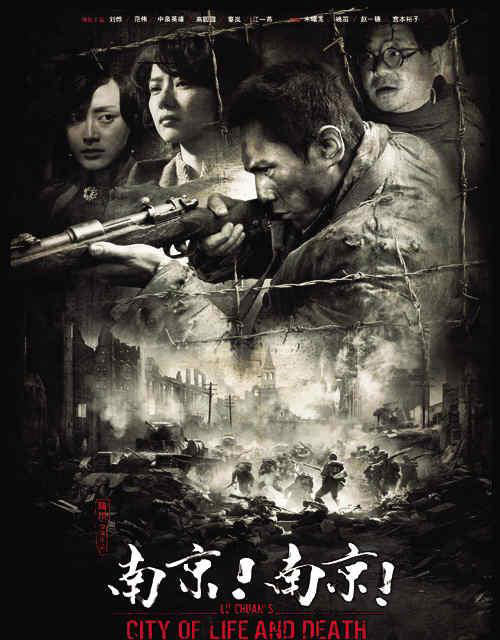
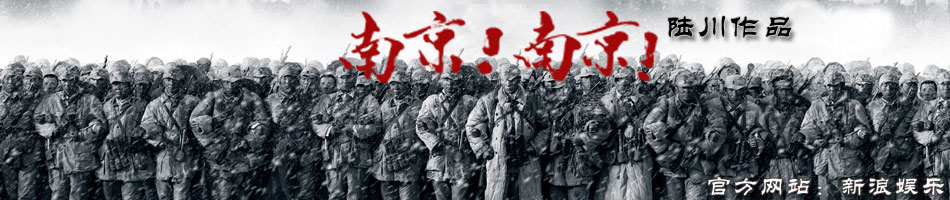
The cast of film 'Nanking!Nanking!', or 'City of Life and Death' [File Photo: sina.com ]Lu Chuan
 said he originally only planed to wade through a river, but he ended up struggling in an unfathomable ocean.
"I had underestimated the capacity and sensitivity of that part of history," Lu said, a day before his movie,
City of Life and Death, was to be screened nationwide in China.
The movie, which has took him nearly four years and cost 11 million U.S. dollars to produce, is about the
Nanjing massacre of Chinese civilians by the
Imperial Japanese Army nearly 72 years ago.
To produce a movie on the subject, which remains a heartrending memory to many Chinese and a stumbling block in China-Japan relations, challenged the director's wisdom, let alone the fact that a dozen of movies with similar themes had already been made.
"All I wanted, in the beginning, was to shoot a movie telling the world how Chinese people resisted the invaders. I didn't expect it could be so difficult," said 38-year-old Lu, who had four-year college education in a
Nanjing-based military academy before entering the movie industry.
The
Nanjing massacre is seen by most Chinese as one of the darkest chapters in history, during which the Japanese army slaughtered nearly 300,000 Chinese civilians and disarmed soldiers following the occupation of Nanjing, then capital of the
Republic of China, in December 1937.
The topic remains a sore point in China-Japan relations. Many Chinese believed that Japan has not fully recognized and sincerely apologized for its war atrocities, while some Japanese historians and government officials frequently claimed that the massacre has been exaggerated or even fabricated for the purposes of political propaganda.
Lu said the idea of the movie came after he completed "
Kekexili" in 2004. Lu's second movie, which was about people risking their lives to save endangered Tibetan antelopes from poachers, won wide acclaim from critics and proved to be a box office hit in China.
"Chinese people were frequently portrayed as weak and helpless victims in the massacre. It's not totally true. There was resistance. That part of history was more or less left out," he said.
"Some people might suspect that by emphasizing resistance, I am making an excuse for the massacre. This is wrong. Resistance (of the defeated) doesn't legitimize massacre (by the victor)," he said.
After more than three years of extensive research, however, Lu underwent "a tremendous shift in perspective." The final version is radically different in storyline and point of view.
"At first, I concentrated on representing the
Rape of Nanking (by
Iris Chang), but gradually, I wanted to explore the laws of nature governing war and how they give rise to massacres," he said.
In the monochrome movie, Lu tried to see the massacre from the eyes of different people, including an ordinary Japanese soldier Kakokawa, who joined the
Imperial Japanese Army out of loyalty to the Japanese emperor, experienced shock and pain in the war and ended up committing suicide in Nanjing.
This narrative approach elicited divided reactions after it was screened for movie critics, media and survivors of the massacre. Many said the storyline of the Japanese soldier was convincing and provided an in-depth look into the war.
"I remember coming out from the screening with tears in my eyes. It was powerful," said Bey Logan, vice president of Asian Acquisitions and Co-production, the Weinstein Company, an independent American film studio.
"The film presents history in very human terms, which is why it's so moving. I think a one-note film about heroic Chinese soldiers and evil Japanese soldiers might be epic, but it wouldn't be nearly as an engaging, emotionally, as this one is," he said.
But others said they were uncomfortable with Lu's audacity to portray Japanese soldiers as human beings, who also suffered from the war.
"The crimes of the Japanese were much worse (than those showed in the movie). I especially cannot accept the image of Kakokawa," 87-year-old Nanjing citizen Zhang Zhenqing said after watching the movie.

"Perhaps Lu Chuan is too young to understand our feelings," said Zhao, who survived the massacre.
The movie also drew attention of scholars.
Liu Jiangyong, a professor on China-Japan relations from the
Tsinghua University, said he would like to watch Lu's movie and see how he interprets the
Nanjing massacre.
"History can always be interpreted from different perspectives. The point is what kind of message the interpretation intends to convey," he said.
"I agree that families of the Japanese soldiers suffered from the war and they were also victims. But as for the Japanese soldiers, they were not. They were the perpetrators," said
Liu Jiangyong.
Faced with the doubts and questions, Lu said by portraying history in human terms, he was trying to open a window for more discourse on both sides.
"Japanese soldiers used to be demonized in Chinese movies," he said. "We have been making such films for 60 years, but they never had any influence in the world or affected the world's understanding of the massacre."
"To continue to wail and whine to the world about the sufferings we had experienced will not work. We need to probe deeply into how and why the war happened," he said.
Trouble also came when Lu tried to find Japanese actors to play the roles of Japanese soldiers, officials and prostitutes.
"We first selected seven to eight famous Japanese actors, but their agencies forbade them to play in the movie. Then we turned to some less well-known actors. But still it took some time to persuade them," he said.
Lu said he deliberately recruited actors who had never set foot in China, because he wanted them to experience China with all the culture shock that Japanese soldiers had when they first landed.
All of the Japanese actors knew little about this chapter of history. Lu said most of them acknowledged the massacre but did not completely agree with him on the issues such as how many Chinese had been killed, and why and how they were killed.
"I waited to let them get the answers by themselves. There is no need for brainwash," he said.
About 100 Japanese acted in the movie. Lu said some of them almost had nervous breakdowns during the filming.
"They cried and asked to leave because the atrocities in the massacre, like raping and killing, drove them crazy. I think their pain and confusion were just what I wanted to present in the movie," he said.
At the premier in Beijing on Thursday,
Nakaizumi Hideo, who played the Japanese soldier named Kadokawa, attracted great media attention. Nakaizumi, in his early twenties, took questions from the media with concise and carefully chosen words.
"I think the role of Kadokawa set an image of Japanese soldier totally different from the previous ones. I hope the role could help the public gain new understanding (of that part of history)," he said.
Nakaizumi said he decided to take the role after a long talk with Lu. "He told me that even though it (
Nanjing massacre) is a taboo in Japan, this movie focuses more on the emotions and mentality of human beings in war."
Despite reports saying that some Japanese actors, who played Japanese soldiers in Chinese movies, had undergone fierce attacks and even death threats back in Japan, Nakaizumi said he did not worry about his future and his friends and families all showed their support.
"I hope more people could watch the movie," he said, when asked whether he thought there would be any possibility for a theatrical release of the movie in Japan.
In contrast to his cautiousness, director Lu was outspoken and confident.
"We must get the movie screened in Japan," he said.
"We are contacting Japanese distributors through some friends. It's difficult. No one dares to buy (a copy)," he said frankly.
"But I think this is a movie that Japanese people could sit through. We will get it screened in Japan, even if we have to give it to the Japanese distributors for free," he said.
"As a matter of fact, I hope the movie could be screened not only in Japan but also around the world," he said.
Logan from Weinstein Company expressed an interest in distributing the movie in North America. But he admitted it would be hard to get the mainstream American audience to see the film.
"It is not because of the film's merits but because the U.S. theatrical market is tough," he said.
Big Hollywood blockbusters fill up the theatres, and its very hard for foreign language arthouse films to get any kind of release, he said.
"But if we were allowed to release the film in North America, we would give it the kind of prestige release it deserves, playing to an audience of cineastes and screening the film in venues where it will be best appreciated," he said.
At Thursday's premier in Beijing, Lu burst into tears after watching a video footage in which his father congratulated him on the completion of the movie.
"My heart was in pain and darkness. It was like in hell," Lu told Xinhua, recalling his four-year odyssey.
"My next movie might be a light-hearted one. Life has so many facets. I don't want to be immersed in pain and misery all my life," he said.